
The Heliospheric Imager for the NASA STEREO Mission
Part of the SECCHI Consortium
Sky at Night Competition
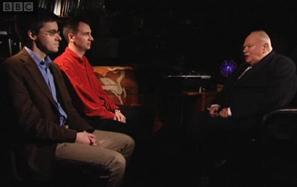 In the April 2008 edition of the BBC's Sky at Night (which
featured the STEREO Heliospheric Imager), Sir Patrick Moore
announced a prize for the observation of the first Vulcanoid
asteroid (asteroids orbiting the Sun within the orbit of Mercury)
in the STEREO HI data. The Heliospheric Imagers are capable of
imaging stars down to around 13th magnitude and so it is indeed a
challenge to observe such objects in our data. STEREO has
discovered at least three comets and several known asteroids have
already been identified in the data so far.
In the April 2008 edition of the BBC's Sky at Night (which
featured the STEREO Heliospheric Imager), Sir Patrick Moore
announced a prize for the observation of the first Vulcanoid
asteroid (asteroids orbiting the Sun within the orbit of Mercury)
in the STEREO HI data. The Heliospheric Imagers are capable of
imaging stars down to around 13th magnitude and so it is indeed a
challenge to observe such objects in our data. STEREO has
discovered at least three comets and several known asteroids have
already been identified in the data so far.
As the two spacecraft move away from the Earth, along Earth-like
orbits, the Heliospheric Imagers look back at the space between
the Sun and the Earth. This design enables scientists to track
Earth-directed coronal mass ejections (CMEs) as they travel into
space from the Sun's surface. This unique viewpoint also gives
us an excellent opportunity to look for Near-Earth Objects
(NEOs) that would otherwise be difficult to observe from the
Earth (because they would lie very close to the Sun as observed
from the surface of our planet). There are two STEREO spacecraft
(Ahead and Behind or A and B), each carrying a Heliospheric
Imager. Each imager contains two cameras; HI1 and HI2. The HI1
cameras view a 20 degree region of the sky with the sunward edge
of the field of view being approximately 4 degrees from the Sun.
The HI2 cameras have a 70 degree field of view starting
approximately 18 degrees from the Sun.
Traditionally, the detection of planetary objects has been
carried out by 'blinking' pairs of images and looking for
anthing that moves between them. STEREO team member Dennis Wang
has written a great web application to demonstrate this
effect. On his webpage
at http://secchi.nrl.navy.mil/index.php?p=js_blink,
you can compare the first and last images taken each day with
the STEREO cameras. January 1st 2008 contains a great example
of a planet moving across the background star-field. If you can
see the same object in images from both STEREO A and B
spacecraft, it means that the object must be between the Sun and
the Earth. When trying to identify a planet or asteroid, don't
forget that the STEREO spacecraft are moving away from the Earth
and so the position of a planet with respect to the starfield
observed from STEREO will be different for an Earth-based
observer.
If you want to look at a region of any of the images in more
detail, you will need to download the files by going to the
'data' tab in the menu on the left of this webpage. Our data
are made available via the UK Solar System Data Centre with
whom you will need to register first (which is free). The
data are in 'fits' files which can be read into many of the
standard packages designed to manipulate astronomical images
(such as registax). While data from all the STEREO telescopes
is available on this website, the HI cameras provide the
widest field of view in which to hunt for asteroids. The
website provides two versions of the data, L0 and L1. These
are NASA-speak for the amount of data processing that has been
carried out on the data. L0 data is raw data, more-or-less as
it comes from the spacecraft. L1 data has been processed to
apply calibration corrections to the cameras and (for HI)
correct for the fact that the cameras do not have shutters
(it's a long story).
The signal in both L0 and L1 HI images are dominated by the
light scattered from the F-corona (or zodiacal light). A CME
is less than 1% of the brightness of the F-corona and so it
has to be removed before these moving features are
revealed. Luckily, the F-corona is very stable and so it can
be estimated (from the minimum value in each pixel over a
series of images) and removed. Once this is done, the
starfield becomes much easier to see (as in Dennis Wang's
blink images). Another way of removing the F-corona is to
subtract one image from the other (so-called differenced
images). These tend to remove anything that doesn't move
relative to the cameras (like the F-corona) and leave behind
anything that is moving (like CMEs, stars and
asteroids). Both background-subtracted and differenced
movies are available from the 'movies' tag in the menu to
the left of this page. We hope, soon, to supply L2 data via
the UKSSDC which will have our best estimate of the
background F-corona removed automatically.
Once you have detected an object moving through the data,
you may want to look at one of the monthly movies (also in
the menu to the left) to see if you can track your object
throughout a much longer period.
Happy hunting!
Chris.